


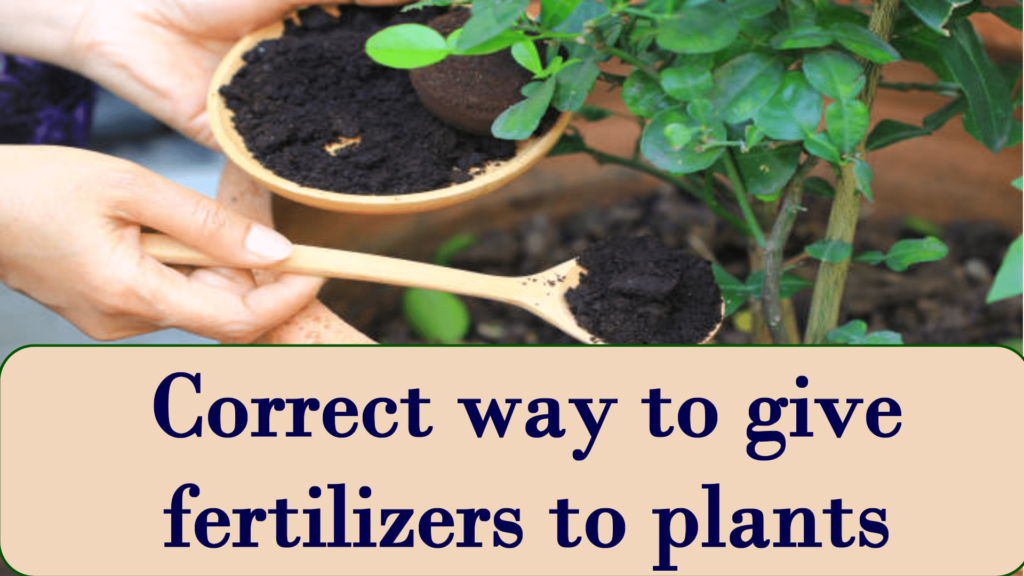
Giving fertilizers to plants is an important aspect of gardening that provides the essential nutrients required for healthy plant growth. Just as humans and other animals require food for survival and growth, plants also require nutrients for growth and production. In the absence of these nutrients, the growth of plants stops and the yield decreases.
For proper nourishment and growth, plants require soil, water, sunlight, fertilizers, as well as human love and care. It’s essential to use these resources effectively and efficiently. This article will address four essential questions (3 W and 1 H- Why, What, When and How) related to feeding your plants:


1. Why should you feed your plants?
2. What should you feed them?
3. When should you feed them?
4. How should you feed them?
Classification of fertilizers for Outdoor plants
Organic fertilizers are rich in organic matter, which helps to improve soil structure, retain moisture, and promote the growth of beneficial microorganisms in the soil. They also release nutrients slowly, providing a steady supply of nutrients to the plants over time.
Some of the fertilizers are mentioned below:
- Compost
- Neem cake
- Mustard cake
- Epsom salt
- Banana peel liquid fertilizer
- Cow dung liquid fertilizer
- Seaweed fertilizer
1. Compost for Outdoor plants


- When making a soil mixture for outdoor plants, compost is a preferred ingredient.
- Compost is a natural fertilizer that is rich in nutrients and can be used to improve soil health.
- It makes the soil porous and also retains water for a longer duration.
- If the soil in existing plants is becoming clayey or tight, adding compost can help to improve the soil quality.
- You can use any type of compost, including cow dung, vermicompost, leaf compost, or kitchen compost.
2. Neem Cake fertilizer for outdoor plants

- Neem cake, a byproduct of neem seed oil extraction, can be used as a natural pesticide and fungicide to prevent attacks by insects, viruses, bacteria, or fungi in soil.
- It helps to improve soil quality by adding essential nutrients, enhancing soil structure, and increasing water retention.
- It can be added to the soil mixture in small amounts as it is very potent.
We can add neem cake powder to the soil mixture as well as we can make neem cake liquid fertilizers and give them once a month.
You can read the detailed article here:
3. Mustard cake fertilizer


- The mustard cake fertilizer is a very strong fertilizer and should be used with caution.
- It is recommended to apply it during the winter season when the weather is cooler and the soil is more receptive to nutrients.
- However, it can also be used during summers, but it is not recommended during extremely hot weather when the temperature is near 40 ℃.
- We can add a little bit of mustard cake powder in soil-mixture as well as we can give mustard cake liquid fertilizer to plants once a month.
- It is important to dilute mustard cake properly in a handsome amount of water before applying it to plants, as it can be too strong for plants if used directly.
You can read the detailed article here:
4. Epsom Salt (Magnesium Sulfate) for outdoor plants


- In cases where plants are not growing properly despite receiving adequate fertilizers, water, and sunlight, Epsom salt can be considered as a good supplement.
- We can either directly add Epsom salt to the soil or make a dilute solution and give it in the soil or can make a foliar spray.
- We have to give Epsom salt only when it is needed.
It is important to use Epsom salt in moderation and always maintain a gap of at least 10 -12 days between the two fertilizers to avoid over-nutrients to the plants.
- This will allow the plants to absorb the nutrients from each fertilizer effectively and prevent any negative effects on plant growth.
You can read the detailed article here:
Epsom Salt for plants: benefits & uses
5. Banana Peel fertilizer for outdoor plants


- Banana peel fertilizer can act as a catalyst for plants during the flowering or fruiting stage, or in cases where the plant is not blooming.
- The high levels of Potassium and Phosphorus in banana peels can help to promote the growth and development of flowers and fruits, while also providing other essential nutrients to the plants.
- The best is to make Banana peel liquid fertilizer and give it to the soil. Otherwise, you can add Banana peel to the Kitchen compost as raw banana peels may attract pests and insects.
- Banana peel liquid fertilizer should be given once every fifteen days.
Must read article on
Banana Peel Liquid Fertilizer
6. Cow dung liquid fertilizer


- Cow Dung liquid fertilizer is a widely used and popular form of organic fertilizer.
- It is rich in nutrients like Nitrogen, Phosphorus, and Potassium, which are essential for plant growth. Additionally, it contains microorganisms that help in the breakdown of organic matter in the soil and improve soil fertility.
- It can be given to any outdoor as well as indoor plants once a month.
It is important to ensure that the cow dung compost tea has been properly aged or composted before using it, as fresh cow manure can contain high levels of ammonia that can harm plants.
You can read the detailed article here:
How to make Cow dung fertilizer for plants
7. Seaweed fertilizer

- Seaweed fertilizer is a natural and organic fertilizer made from seaweed extract.
- It is rich in micro and macronutrients.
- Seaweed fertilizer can be used on a wide range of plants, including vegetables, fruits, herbs, flowers, indoor plants, plant cuttings in water, etc.
- It can be applied in the form of granules as well as liquid fertilizer.
- We can do foliar spray, soil drench, or add directly to the growing medium of plants.
- It can be given to any outdoor plants once a month.
You can read the detailed article here:
Seaweed Fertilizer: Benefits and Uses
Important points to note:
1. All the liquid fertilizers are endowed with balanced nutrients like NPK, Magnesium, Zinc, Calcium, and all other nutrients.
2. Rotation of the above-mentioned fertilizers is recommended every 20-25 days.
3. A deficiency of nutrients can be recovered in the plants but excess nutrition will damage the plant. So, even if you are giving any tonic or any supplement to plants always maintain the suggested time gap of at least 10-15 days.
4. Vegetable plants such as tomatoes, green chilies, brinjal, cabbage, bitter gourd, etc. should be fertilized with liquid fertilizers every 20 days.
5. For other outdoor plants, including both flowering and non-flowering ones like Tulsi (Holy basil) and Curry tree, etc. and Hibiscus, liquid fertilizer should be applied every 25 days.
Fertilizers for Indoor Plants


- It is important to select an appropriate fertilizer for indoor plants, as they have specific nutritional needs. A balanced fertilizer with equal amounts of Nitrogen, phosphorus, and Potassium as well as micronutrients is often recommended for indoor plants.
- Indoor plants such as ZZ plants, Areca Palms, Syngoniums, Money plants, Anthurium, Snake plants, Peace lilies, etc. require nutrients approximately once every two months during their active growth period, typically in the spring and summer months.
- Giving fertilizers to these plants during the dormant period in winter is generally not recommended, as they require less water and nutrients during this time.
Fertilizers: 

- Cow Dung fertilizer is the most suitable fertilizer for this category.
- Mustard cake fertilizer can also be given to them once a year.
- Seaweed fertilizer (granules/liquid fertilizer) can be given once in a 2 months gap.
Vegetable plants need water, sunlight, fertilizer, and everything in a maximal amount whereas indoor plants need minimal of everything.
Prioritize your plants and pick suitable fertilizer to nourish them.
Happy Gardening !!