


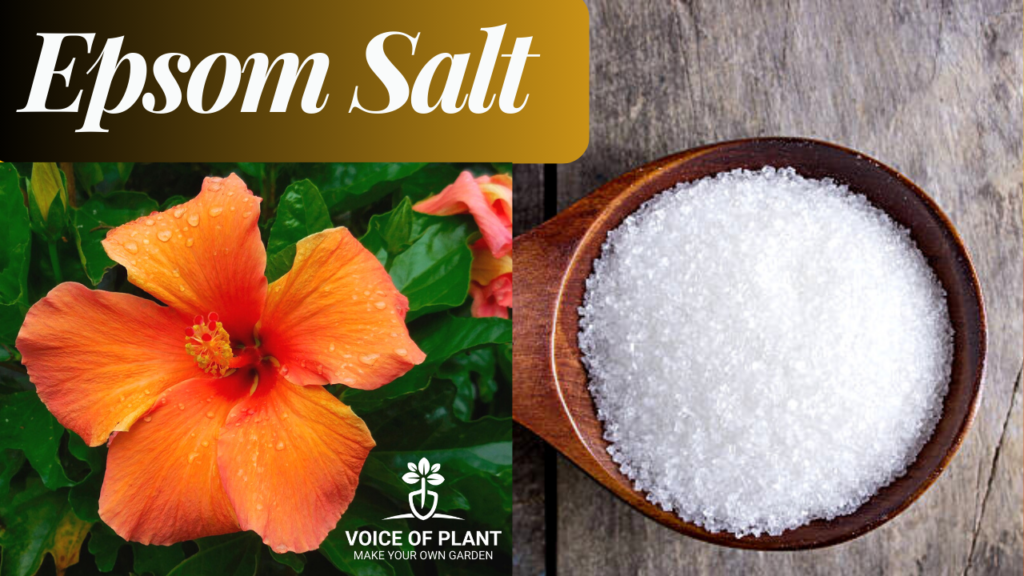
Have you ever noticed that despite providing everything necessary for healthy plant growth—such as the right soil, suitable pots, adequate sunlight, optimal temperature, quality water, fertilizer, and pest control—your plants still fail to thrive as expected? That’s where Epsom salt can work its magic!
Epsom salt can work wonders for your plants when used wisely, aiding in providing proper nutrients and promoting full growth. It is rich in magnesium and sulfur.

Do you know?
“Magnesium sulfate increases the amount of chlorophyll and keeps the plants green. It can be used for all crops like cereals, pulses, oilseeds, fruits and vegetables, cotton, sugarcane, etc.”
In this blog, we are going to discuss-:
- Various facts about Epsom salt,
- Why should we use Epsom Salt?
- What is Epsom salt?
- How to use Epsom salt?
But what exactly is Epsom salt? Is it the same as table salt, rock salt, or the kind used during fasting? Let’s delve into this topic in detail.”
Epsom Salt for Plants


If you search on Google for information on Epsom salt, you may come across results suggesting that it is “sendha namak” or rock salt (NaCl – Sodium Chloride), which is entirely incorrect.
NaCl, or table salt, is indeed edible, whereas Epsom salt is not.
Important note:
- It is crucial to avoid using edible salt in the planting process, as it could potentially harm your plants, leading to adverse outcomes.
Epsom salt, scientifically known as Magnesium Sulphate
Epsom salt, scientifically known as Magnesium Sulphate (MgSO₄), serves as a beneficial supplement for plants. You can easily purchase Epsom salt online, from a nursery, or from any medical store.
- Additionally, Epsom salt is sometimes recommended by doctors for its therapeutic properties, such as for relieving swelling, through methods like Epsom salt fomentation.
Myth about Epsom Salt
There is a common misconception that Epsom salt purchased from medical stores may not be as effective for plants, but this notion is entirely misleading.
Whether you buy Epsom salt from nurseries, online markets, or medical stores, the properties of the salt remain consistent.
- All varieties of Epsom salt will perform the same function for plants, regardless of where you purchase them.
Why do we need EPSOM salt for the plants?
Generally, plants need seventeen essential nutrients for maintaining their health, some of them are Nitrogen, Potassium, Phosphorus, Magnesium, Zinc, Sulphur, etc.
The Importance of Magnesium and Sulfur for Plant Health
1. If plants lack Magnesium, then their chlorophyll level will get affected negatively, which in turn will hamper the process of photosynthesis and it might weaken the particular plant and its growth.
- Moreover, if plants will not produce chlorophyll, the natural green color of leaves will be affected.
2. As our body requires proteins and fats, similarly plants also require fats and proteins for optimal growth and lack of magnesium stops the formation of proteins and fats in plants.
3. Now, the next important nutrient is Sulfur, which is very essential to maintain the green color of leaves.
- Lack of Sulfur in plants is the cause of leaves starting to turn yellow and plus it stops cell division also, hence, no new growth in the plants.
- Your plant will have no new leaves, no new branches, no flowers, no new buds, no fruits, and absolutely nothing.


4. But, Epsom salt is full of Magnesium and Sulfur both. So, if you use Epsom Salt for plants, then it will boost their growth and the green color of the leaves will be maintained.
5. Generally, sometimes you might have noticed that the growth of Curry plants gets hampered even after taking tremendous care of the plant.
- In that condition, try the Epsom salt once and you will notice visible changes in the growth of the plant.
- Plus, you will find that new leaves are coming and the size has also broadened.
How to use Epsom Salt for plants?
There are two ways in which you can provide Epsom Salt to your plants:
1. First Method – Dissolve 1 tablespoon (tbsp) Epsom Salt in 1 Liter water. Now, spray this solution on plant leaves. In this procedure, Epsom Salt will enter the plant through the pores of leaves.

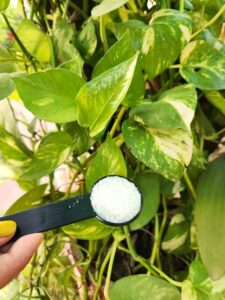
2. Second Method – Loosen your soil, and dig it a little. After that, put Epsom Salt in the soil.
- In case you have a big pot use 1 tablespoon (tbsp) and use ½ tablespoon (tbsp) Epsom Salt in case you have a smaller pot.
- Again, cover it up with soil and mix it generously. After that, give water to the plant.

In these two methods, the second method is relatively more effective because when roots absorb Epsom Salt, it will be equally distributed throughout the plant.
1. In the first method, i.e. using the leaf spray method, in spite of many spray hits not every leaf will receive the solution, plus there is a possibility of getting the solution wasted.
2. One more thing you can follow both the process parallelly also. If you want, you can put some Epsom Salt in the soil and you can spray it on the leaves.
After this procedure, wait for 8-10 days, as it will work slowly and gradually. It is not magic that will show results instantly.
- So, after giving Epsom Salt for the first time, repeat the same procedure after 8-10 days again. And you will see visible changes in the growth of your plant.
Excess of everything is bad and the same is the case here also. Epsom Salt is not a fertilizer. Hence, it must not be used repeatedly in plants.
Important points
1. When given repeatedly, it might increase the concentration levels of Magnesium Sulphate and the balance of other nutrients might be affected which will worsen the condition of your plant.
2. You should use Epsom Salt only when your plant needs it.
3. If your plant is looking dull and its growth is totally hampered then first you should give fertilizers to the plant and check for pest attacks.
4. If everything is fine with your plant and still its growth is hampered then you can use Epsom Salt for your plant without any fear.
5. Epsom Salt can be used for your indoor, outdoor, flowering, non-flowering, vegetable, and any other kind of plant. People often use it for their money plants and curry leaves plants.
That was all about “EPSOM SALT”.